

How do you run a war?
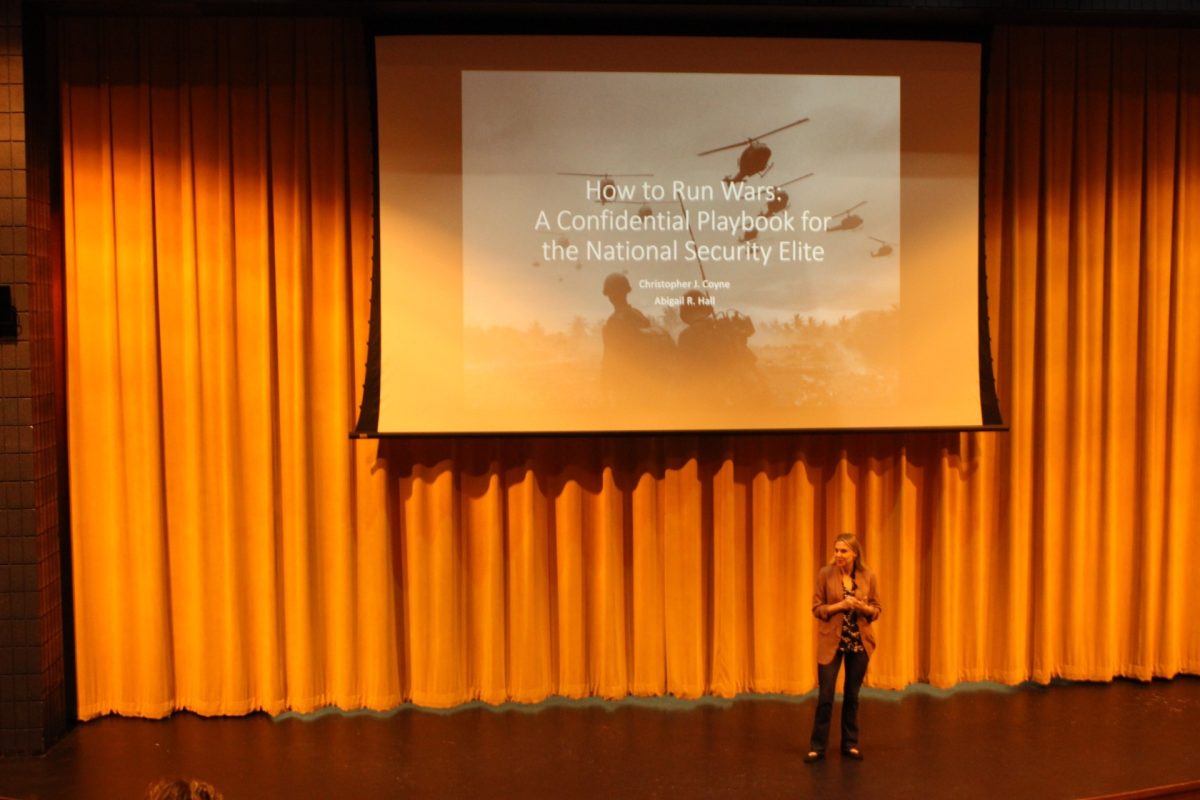
Guest speaker Dr. Abigail Hall Blanco presented a fresh, challenging perspective on U.S. policy and what has driven endless wars worldwide at a recent speech on campus. Blanco, an award-winning economics and associate professor of economics at the University of Tampa, came to UNH to discuss her bestselling novel, “How To Run Wars: A Confidential Playbook for the National Security Elite.”
Blanco began her presentation with a disclaimer: “One of the things that my co-author and I have been criticized for (reasonably) is that we are very often times critical of the U.S. government and U.S. foreign policy in particular,” said Blanco. “And so in discussing this, we thought, well, what if instead of only criticizing, we instead decided to offer advice.”
Throughout Blanco’s presentation, she discussed an issue and then proposed a solution to that problem through historical examples. In the book, the authors use history as a guide by implementing quotes and examples to support their claims.
“In this book, what we attempt to do is we utilize the work that we’ve done to offer this kind of satirical take on U.S. foreign policy,” said Blanco.
The first question was, how do you craft your message?
What Blanco meant by this was that in order to run a war, you need to craft a narrative, and that narrative has to be right or seem right. This involves controlling what information goes out to the public and what does not.
Here is where propaganda plays a role. Propaganda seems like a bad word, but Blanco presents a different perspective. A quick and simple example is when, in World War II, they used Donald Duck to introduce income taxes.
“Donald Duck is a good American, he pays his taxes, he doesn’t he supports Hitler,” said Blanco.
She explained that, though it is harsh messaging, it still works, and what also works is paid patriotism. On the screen were two shows, “Hell’s Kitchen” and “Say Yes to the Dress.” Focusing on “Hell’s Kitchen,” or anything with Gordan Ramsey in it, she pointed out there’s always a nod to the U.S. military.
“It’s a beautiful exchange between the Department of War, Department of Defense makes an offer to allow film studios and tv production companies to utilize military equipment personal and locations in exchange for a say in the editorial process,” said Blanco.
With war comes casualties. What do you do about casualties?
“We decide when data is released, we decide what data is released, the timing of data release can be fundamentally important,” said Blanco.
As an example, Blanco presented the case of Pat Tillman, a victim of a planned out information release about the truth of his death while on duty.
He was deployed to Afghanistan and died in battle from fratricide. He was accidentally killed by his fellow soldiers. The truth about Tillman’s death wasn’t released until after Tillman’s unit and brother, who also enlisted, found out.
“But remember, you get to choose when data is released, so they decide to do it over a three-day holiday weekend on a Friday afternoon after many reporters had already gone home for the day,” said Blanco.
Blanco also touched on issues of finance, failure and dissent, offering solutions and a unique perspective for each.
“Specifically, we want to really highlight for individuals who read this book, what is fundamentally required if we want to maintain kind of the contemporary foreign policy status quo and if we hope to be successful in foreign interventions in the future,” said Blanco.