

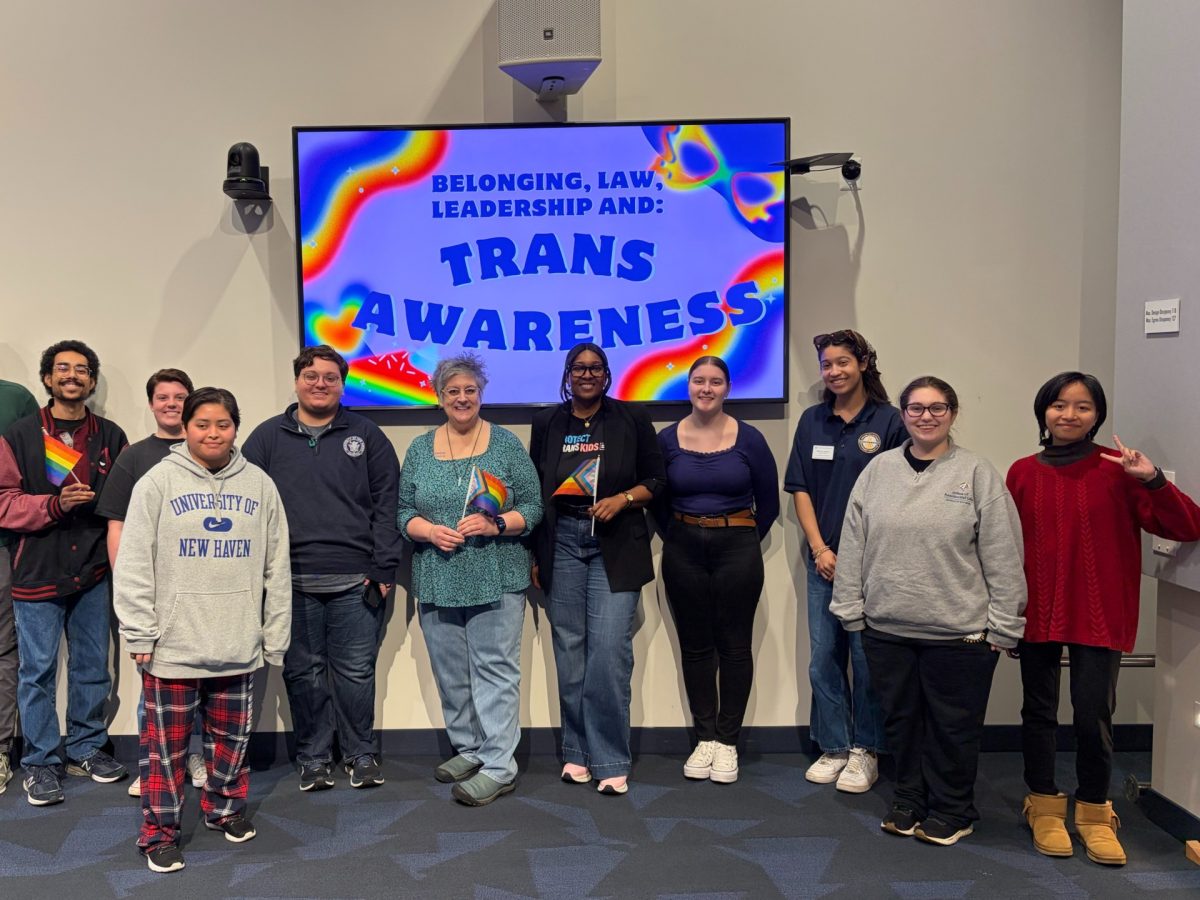
An event, “Belonging, Law and Leadership: A Transgender Awareness Event,” was held to educate students on how to support transgender peers was held earlier in April.
The event was hosted by the university’s Undergraduate Student Government Association (USGA) and the university’s People Rejoicing in Diversity Everywhere (PRIDE) club.
The event featured a panel hosted by USGA senator-at-large Cam Fernandez and panelists Sonia Murphy, the founder and program director for nonprofit organization Rainbow in Black and partner for law firm Gilbert LLP, based in Washington D.C., as well as Michele Polak, one of PRIDE’s advisors, a Safe Zone trainer and the university’s director of academic assessment under the Office of the Provost.
In addition to educating students, the event allowed students to share stories and it provided resources. One of the first questions focused on advocacy. Murphy discussed how advocacy has been a lifelong calling of hers and that she was inspired to become a lawyer after watching the sitcom,“A Different World.” This was the first show where she saw Black students in college, as well as the character Clair Huxtable from “The Cosby Show,” who works as a lawyer.
“I always wanted to be an advocate,” said Murphy. “I went to law school knowing that I wanted to do something with my life that involved using my voice for good. I wanted to help people.”
Pollak discussed what got her motivated to advocate for others, referencing stories she encountered within the Queer community in Cleveland, Ohio. She said she felt privileged to be able to come out as lesbian. After going through college, she wanted to have a voice for people in the community because she felt she had the platform to advocate more for others.
“I remember not having that voice,” she said. “I found my footing. I need to try to pass that on and instill to other people. You just got to find your footing and it’s ok if you don’t come out now.”
Pollak also spoke about how college fosters a safer environment for self-exploration compared to most environments at home.
“So, if you decide you want to attend a pride meeting, that’s OK, nobody’s gonna go back to your uber-Christian mother and tell her, this is not gonna happen,” Pollak said.
Fernandez agreed and said it’s important to find your community in college because that makes it easier to explore without being ridiculed.
The panelists also discussed how civil rights law intersects gender identity on college campuses. Murphy discussed how the current U.S. government has targeted transgender Americans, and used Immigration Customs & Enforcement officials on religious properties.
Referring to a family member’s identity she said, “That doesn’t infringe on your rights at all, and so when the government or anyone is trying to attack that for absolutely no reason, you have no compelling interest, that to me is a problem, and that is when advocacy kicks in.”
When Pollak discussed how a part-time faculty member had repeatedly deadnamed a student who had transitioned. She said she had a meeting with the teacher and tried to explain that calling someone by their preferred name is optimal.
“I’m like, so you see how easy it is to just call someone by the name that they ask you to call them, or use their pronoun, and I needed to sit with this adult,” she said. She also said that the teacher could have been fired from the university if they had continued to refer to the student by their deadname.
Pollak cited numbers from the Trevor Project that said the rates of transgender youth considering suicide have risen and that one in three trans youth have attempted suicide. She also said that something as simple as calling someone by their chosen name or pronouns could prevent someone from thinking about suicide. Murphy added that the rates for suicide decrease by 40% when a young person has a affirming adult, someone who recognizes and supports a child’s sexuality or identity.
“Just one, and that doesn’t say family member,” said Murphy. “Literally just one affirming adult, and when I read that, I said, I will be an affirming adult for anybody that needs.”
Pollak said she feels the university is one of the safest spaces for queer communities among the campuses at which she’s taught, while acknowledging there’s room for improvement. She said the university offers inclusive practices such as allowing students to use a chosen name during registration.
“The minute you fill out a form online and say, ‘I’d like to change that,’ they will,” said Pollak.
She also said the university refused to comply with Pres. Donald Trump when it came to using certain language that he wanted to ban across campuses.
“Everybody’s like, ‘We’re gonna keep this,’” she said, “We’re gonna keep this detailed language.”
Both Murphy and Pollak encouraged attendees to support others. Murphy suggested using pronouns on Zoom meetings, while Pollak urged students to attend PRIDE meetings and get more involved on campus through outreach and participation. Pollak also encouraged people to attend her Safe Zone training sessions to learn how to create supportive and inclusive environments for LGBTQIA+ students and staff.