


(Ira Kleinfeld)
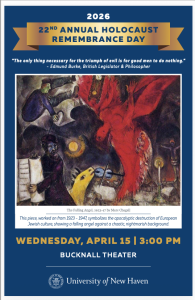
For Ira Kleinfeld, the man behind the university’s annual Holocaust remembrance ceremony, the story he shared at the event is deeply personal and rooted in his family’s history.
Kleinfeld, a professor emeritus in the Mechanical and Industrial Engineering Department, began the ceremonial tradition over 20 years ago, motivated by his parents’ story.
“My mother fled from Berlin just before WWII broke out and my dad left Vienna similarly,” said Kleinfeld. “My mother’s family was devastated. Her parents were murdered at Auschwitz and most of the rest of the family perished also. My dad lost his sister and her children.”
While remembering these events is essential to preventing them from happening again, many people around the world do not care for them, believe in them or know about them.
“The world has a very checkered record on remembering the victims of the Holocaust,” said Kleinfeld. “In some places, particularly in North America and Israel, the record is quite exemplary. Other places less so, even to the point of Holocaust-denial, such as in Iran.”
Kleinfeld attributes this disparity to viewpoints on antisemitism, as reflected in the International Holocaust Remembrance Alliance (IHRA). The definition has been adopted by multiple countries, international agencies and organizations.
“The reasons for that can be correlated with the official viewpoints about antisemitism,” said Kleinfeld. “Where antisemitism is officially and vigorously condemned by society, Holocaust memorialization is strongest; and vice-versa.”
Kleinfeld expressed uncertainty on addressing the issue on a global scale.
“Antisemitism is an ancient, stubborn hatred with modern-era nuances that are now deeply rooted,” he said. “And the world is fragmented politically. So, addressing this problem world-wide seems overwhelmingly difficult.”
The world may still deal with antisemitism, but the best way to prevent another Holocaust from happening again is simply remembering.