

Perspective
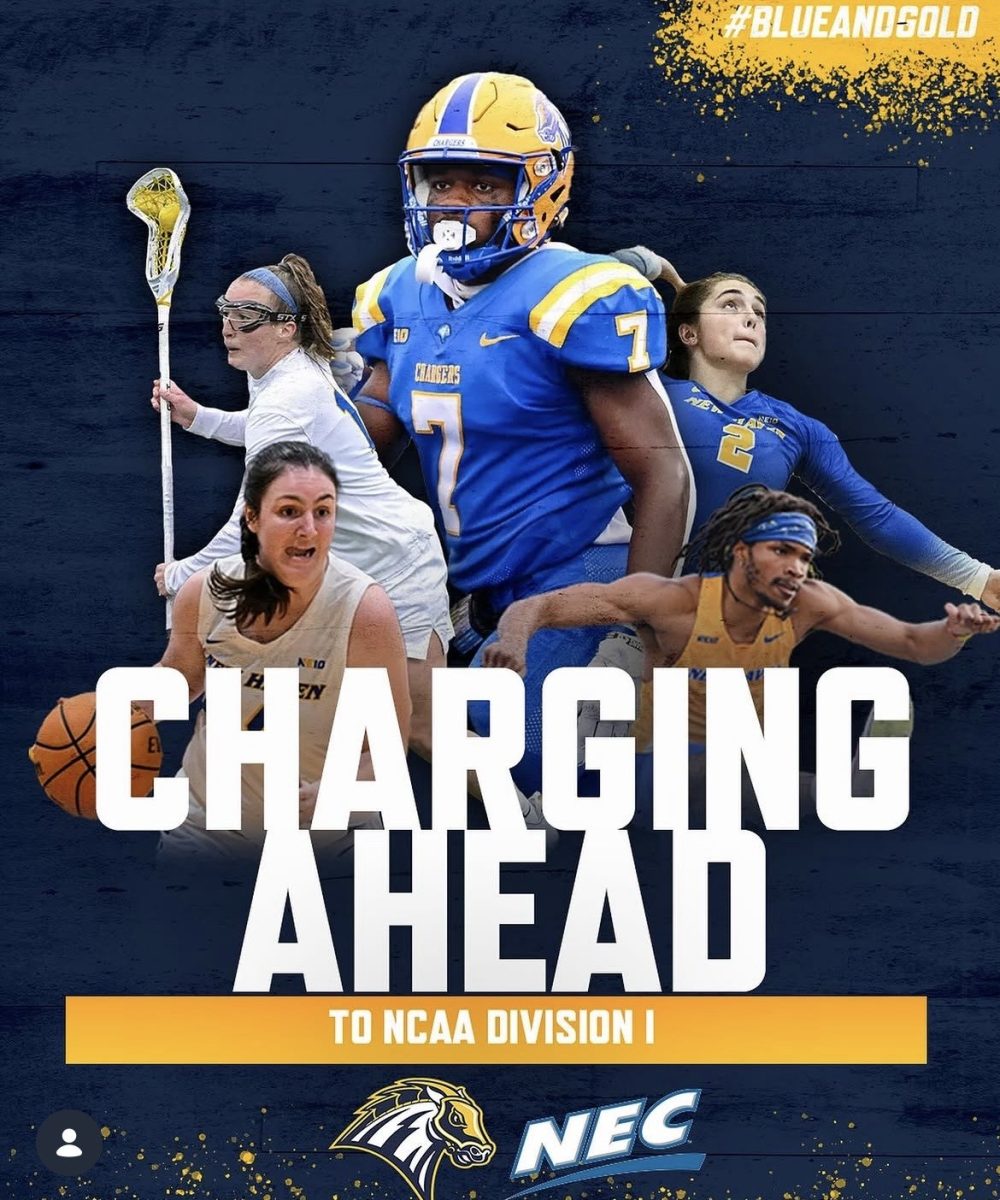
The university’s move to Division I and the Northeast Conference had been discussed for more than a decade. But when the move became official, it marked a major shift in the university’s athletic identity. University leadership and athletic officials framed the transition as a long-awaited step forward, one that would elevate both competition and national visibility.
At the same time, the decision raised a larger question: Was the program ready?
The numbers suggest the university has been competitive throughout its first year at the Division I level. The men’s basketball team finished 14–17 overall and 9–9 in conference play, which shows it could hold its own against NEC opponents like Central Connecticut State University and Long Island University. The football team, still transitioning out of Division II scheduling, posted a balanced 5–5 record while averaging nearly 28 points per game and matching opponents in total offense.
A closer look, however, shows the adjustment has not been seamless across all programs. The women’s basketball team struggled to have a 7–22 record and a 5–13 mark in conference play. Early-season matchups against established Division I programs such as Xavier University and Boston University highlighted gaps in depth and consistency that often come with moving up a level.
The university built a strong reputation at Division II by consistently fielding competitive teams across multiple sports. Success at that level often depends on depth, development and experience, all of which take time to translate against faster and more physically dominant Division I competition. Early results suggest a program still adjusting rather than one fully ready to compete at the highest level.
Still, not everyone sees the movie as premature. Thomas Delucia, a sophomore in sports management, believes the timing made sense given how teams performed in their first season.
“I thought it was good timing to be honest,” Delucia said. “We didn’t do that bad in all of our sports, had a few good wins, so I think it was a good year for us to move.”
His perspective reflects optimism surrounding the transition. Competitive conference performances and flashes of success suggest that New Haven is not overwhelmed, even if it is still finding its footing.
Off the field, the transition has had a broader impact on the student experience. The university has emphasized that the move to Division I would boost enrollment, visibility and overall campus energy. That growth is already reflected in incoming classes. The Class of 2028 brought in nearly 1,400 students, while the Class of 2029, the first to enter during the Division I era, was more selective and nationally diverse, which could signal increased interest in the university.
At the same time, some students say they feel the increased focus on athletics may have come at a cost. Michael Crowley, a sophomore communications major involved in broadcasting, described how the shift has impacted areas outside of varsity sports, and worries that outdated and broken broadcasting equipment has not been prioritized for repair, which has limited the number of students in broadcasting.
For students such as Crowley, the concern is not about opposing the move to Division I, but about balance. While athletics may raise the university’s profile, students still come to New Haven to build careers in fields like media, communications and production.
The transition to Division I has brought clear benefits, including increased exposure, stronger recruiting potential and significant financial backing, such as a $5 million donation supporting athletic facilities. At the same time, it has exposed growing pains, both in competitive results and in how resources are distributed.
So, was the move too early?
The answer lies somewhere in the middle. On the field, New Haven has proven it can compete, but inconsistency shows it is still adapting to the demands of Division I. Off the field, the university is growing, but that growth has come with trade-offs that are affecting students.
Ultimately, the move to Division I was not too early, but it was ambitious. Whether it proves successful will depend on how well the university supports not just its athletes, but the broader student body moving forward.